Workers Comp Coverage After Leaving a PEO
Request loss-run records months before leaving your PEO to avoid coverage gaps and rate surprises.
Workers' comp coverage does not transfer when a company leaves a PEO. A growing company moving off a PEO with 80 employees across several states will find that getting this sequence right, starting the loss-run request months before notice, limits the exit to a single day of uninsured exposure or less.
Why workers' comp becomes your problem after leaving a PEO
A PEO operates on co-employment: the PEO and the client company jointly employ the workforce, and the PEO's master workers' comp policy sits over every client in its book. That structure makes coverage efficient while the relationship lasts, and it also makes coverage non-portable the moment the relationship ends. Coverage stops on the date the PEO agreement says it stops, full stop in legal terms if not in practical ones, and every day after that without a replacement policy in force is a day the employer carries the full liability of an uninsured workplace injury.
This is a structural fact about how co-employment works, not a flaw in the PEO model. The cost of that convenience becomes visible only at exit, when the company that benefited from pooled risk must suddenly stand on its own.
Standing on its own takes time it may not have budgeted for. It is the period during which an injury on the job becomes the employer's direct financial and legal exposure, with no policy behind it.
The experience modification rate problem that most exiting companies don't see coming
A data gap underneath the timing issue is what catches most exiting companies off guard. A company that has gone years without a workplace injury may still arrive at exit with no mod of its own to show a new carrier, because the master-policy structure never generated one.
Three policy models exist within the PEO world, and which one a company has been operating under determines how severe this problem is. Under a master policy, loss history and mod are pooled across all clients, and leaving means starting the experience-rating process from scratch. Under a client-secured or client-purchased arrangement, the employer already holds its own policy, and the PEO only manages claims handling and safety services, so exit requires no underwriting restart.
The consequence of being in a master policy is that a company with a genuinely clean safety record cannot prove that record to a new carrier without years of loss runs in hand, and some PEOs make those records difficult to obtain even after the contract has formally ended. A company with a mod above 1.0 faces the opposite situation: pooling may have softened the cost of a worse-than-average claims history, and standalone coverage exposes that company to the full actuarial weight of its own record for the first time.
Rhode Island's § 5-75-9 is one of the few state statutes that explicitly requires a PEO to provide loss-experience records to a client upon termination if the client requests them. Most states impose no comparable obligation, leaving access to loss-run data a matter for contractual negotiation. That difference, present in one state's statute and absent almost everywhere else, is part of why reading the PEO agreement itself becomes the next necessary step.
PEO contract terms on who owns the coverage data
The right to loss-run records and mod data at exit comes down to what the PEO agreement says and what the relevant state requires, and most companies do not look closely at either until they are already mid-transition. That sequencing error is avoidable. The contract is a governing document that was signed well before anyone started thinking about departure, and it specifies, or fails to specify, which party holds the workers' comp policy, what happens to claims still open at termination, and what records the PEO is obligated to hand over on the way out. Loss-run access is consistently one of the most common friction points in PEO departures, so it is worth locating in the contract language before, not after, giving notice.
A handful of clauses matter more than the rest. And it should state the exact termination notice period required, commonly 30, 60, or 90 days, along with the precise effective date on which coverage stops.
Tail coverage deserves particular attention because it is a substantive issue, not a formality buried in boilerplate. Short-rate penalties carry similar weight: PEO policy term documentation confirms these penalties are calculable in advance, and a mid-term exit on a substantial workers' comp premium can carry a penalty large enough to erase whatever savings the company expected from leaving.
Understanding whether a PEO used a master policy, an MCP, or a client-secured model is one of the first things worth establishing, since it determines the post-exit premium and whether there is any portable loss history to show a new carrier. Tools that integrate with a company's existing employee records system and can audit PEO contract structures ahead of an exit help surface this gap early. None of these facts, the named insured, the tail-coverage terms, the penalty structure, the notice period, should be discovered for the first time after notice has already gone out the door.
The sequencing of a clean exit
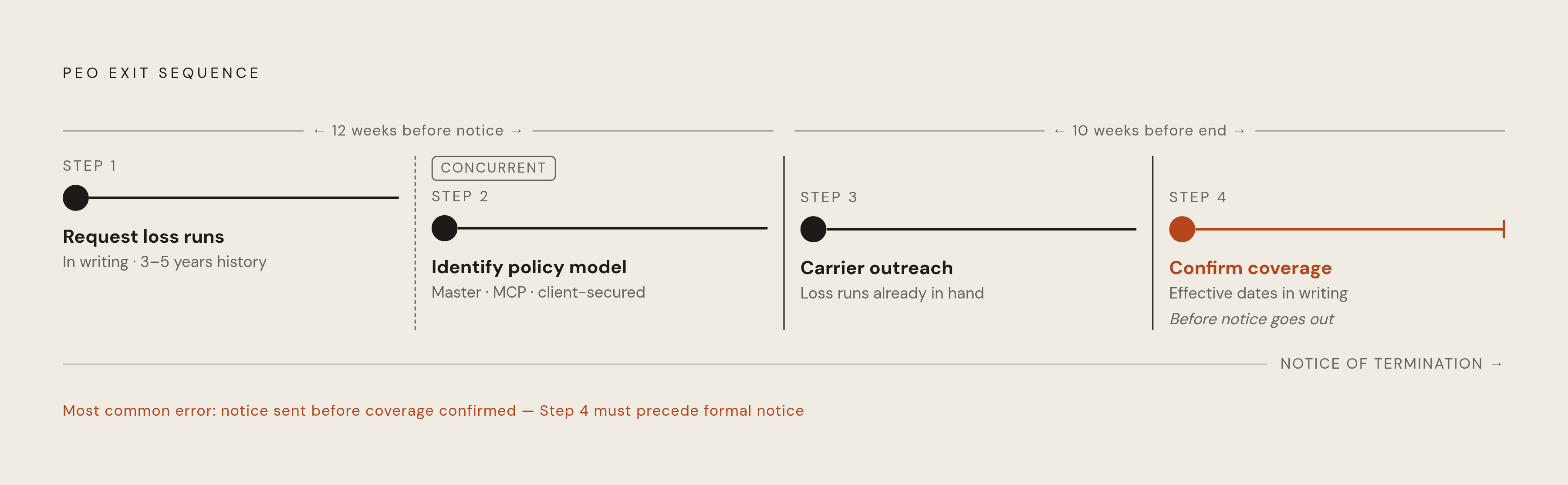
The trigger for the entire exit sequence is the loss-run request, not the notice of termination. Most companies reverse this order instinctively, treating the PEO exit as a procurement exercise that starts with shopping carriers and ends with paperwork, when the correct sequence starts with pulling records long before any carrier conversation begins.
Step one is requesting loss runs from the PEO at least 12 weeks before notice goes out. The request should go in writing and should specify how many years of history are needed, typically three to five years depending on the carrier and the state. Under an MCP model, loss runs and the individual mod should be available as distinct, separable data; under a master policy, the PEO may need to produce a letter of experience in place of a traditional mod.
Step two runs concurrently with step one: identifying which of the three policy models the company has actually been operating under. That answer shapes every underwriting conversation that follows.
Step three is beginning carrier outreach with loss runs already in hand, starting at least 10 weeks before the PEO relationship ends. For employers with workers spread across multiple states, separate coverage arrangements are required in each jurisdiction, and multi-state workers' comp coordination is consistently one of the most complex operational elements of a PEO departure.
Step four is confirming effective dates and coverage continuity in writing before the PEO ever receives formal notice. Giving notice first and starting the carrier search afterward is the single most common sequencing error in PEO exits, and it is the one this entire structure exists to prevent.
Most carriers need at least 30 days to underwrite and issue a new standalone workers' comp policy, which is why this sequencing matters as much as the coverage itself. Early visibility into contract terms and exit timeline lets a company map the carrier lead time and work backward from the PEO's termination date, rather than discovering the lead time only after notice has already gone out.
Standalone workers' comp costs and classification codes
A standalone workers' comp premium is built from three inputs: payroll, industry classification codes, and the experience mod.
Rates vary dramatically by job classification, and that variation operates at the level of the individual role. The classification of each specific role, not the company's industry label, is what sets the base rate an underwriter applies.
The mod complicates that picture for companies coming out of a master-policy PEO arrangement. But the mod is the multiplier applied on top of the base rate, and under a master policy the individual mod was never developed separately. That means the first standalone policy year is often underwritten at a default mod, typically 1.0, rather than at whatever the company's actual performance would justify, simply because there is no documented history yet to replace the default.
For high-salary tech workforces, the payroll base used in the premium calculation is large even though the rate applied per hundred dollars of payroll is small, which makes accurate classification especially consequential. Requesting a formal classification review as part of the underwriting process, to confirm each role is coded to the correct NCCI or state equivalent code, is a standard and worthwhile step before a policy is bound.
Multi-state hiring and the compliance picture after PEO exit
A distributed workforce multiplies the compliance surface a company has to manage, because each state where an employee works is its own jurisdiction with its own coverage requirement, its own audit cycle, and its own rate structure. Workers' comp coverage is legally required in every state except Texas, where it remains optional under state law even though most clients and carriers in practice still expect it. In Ohio, Washington, Wyoming, and North Dakota, coverage has to come from the state's monopolistic fund before the first employee in that state is hired, since private carriers are barred from writing workers' comp policies there.
Under the PEO, all of this ran in the background. After exit, the employer has to build or buy that capability itself, and the gap left behind includes the entire registration and compliance workflow that used to run automatically whenever the company hired into a new state, not just the insurance policy.
The compliance obligations that activate the moment the PEO relationship ends
Workers' comp is the most urgent obligation a PEO exit triggers, but it is one node in a larger cascade, and several of the other obligations carry deadlines shorter than most HR teams expect. A company that solves workers' comp has addressed the most visible issue, but the most time-sensitive ones may still be waiting.
Health benefits are the clearest parallel case. The PEO's master health plan cannot be carried forward any more than its workers' comp policy can, and the company has to become its own plan sponsor with replacement coverage effective on the exact day the PEO's plan ends. Employees who waived PEO coverage because they had coverage elsewhere get a HIPAA special enrollment opportunity under the new plan if that other coverage is later lost. Employees who waived without having other coverage can generally enroll during the transition window, but they do not have a guaranteed special enrollment right the way the first group does.
COBRA administration shifts to the company as the new plan sponsor, and the notice deadlines are tight: 44 days from a qualifying event, or 14 days after the plan administrator is notified of the event when the employer and administrator are separate parties. Employers sponsoring ERISA-governed group health and welfare plans above the applicable participant threshold also need to file a Form 5500, a task that ran as an automated, scheduled filing inside the PEO's compliance infrastructure and now needs to be replicated independently or through a benefits partner.
Every benefit plan also needs a current plan document and summary plan description that meets ERISA standards, and carrier-provided paperwork does not always clear that bar on its own, which typically means a separate wrap document is required, another task the PEO used to handle without the company ever seeing it happen. State payroll registration has to be completed before the first payroll run in any new state, on a timeline measured in days.
A company that plans only for workers' comp and discovers a COBRA notice deadline or a Form 5500 filing requirement on day 31 has solved the wrong problem first.
Running benefits and workers' comp after the PEO without rebuilding one
The right operating model after a PEO exit separates what the PEO bundled together, co-employment, risk pooling, and administrative overhead, from what the company actually needs going forward: plan design, workers' comp coordination, and ongoing compliance monitoring, delivered without a per-employee fee and without a co-employment arrangement locking the company in again.
Three models realistically cover this ground. An AI-native brokerage such as Spine provides plan design benchmarked against the full carrier market at every renewal, compliance monitoring across ACA, ERISA, COBRA, and Form 5500 obligations spanning more than 10,000 jurisdictions, payroll and onboarding operations, and round-the-clock employee support, at no direct cost to the employer since the model is paid by carriers the way a standard broker is. That model was built specifically for tech companies that have outgrown PEO co-employment but are not yet large enough to justify standing up a full in-house HR function.
Workers' comp specifically benefits from a brokerage partner with genuine multi-state experience, one that can manage loss-run retrieval, carrier outreach, classification review, and policy coordination across every jurisdiction a company operates in. That is the operational capability that actually replaces the PEO's risk management function, without requiring a return to co-employment to get it. A compliance layer that continuously tracks state and local requirements, handles registration and filing across all 50 states, and surfaces deadlines before they turn into penalties performs the same ongoing function the PEO used to discharge, minus the bundled co-employment structure that came attached to it.
The evaluation criteria for any post-PEO partner map directly onto the obligations this piece has walked through: loss-run portability support, carrier market access, multi-state workers' comp coordination, COBRA and Form 5500 administration, and ongoing compliance monitoring. A traditional broker tends to cover the first two of those five, since the goal of a clean PEO exit was never to rebuild the PEO but to make sure every obligation the PEO used to discharge is covered by someone, from day one, without co-employment standing behind it.