Payroll Migration Off a PEO to a Standalone Provider
Exiting a PEO requires sequenced legal and operational steps, not a simple vendor switch.
Migrating payroll off a PEO is a sequenced operational project with hard dependencies: tax account registration, data extraction, benefits continuity, and payroll cutover all have to happen in a specific order, and getting any one of them out of sequence creates liability, duplicate filings, or broken paychecks for employees who did nothing wrong.
The PEO structure creates a genuine operational dependency, not just a vendor relationship
Leaving a PEO is rarely difficult because the decision itself is hard. It is difficult because the co-employment arrangement has woven the PEO into the company's legal and tax identity, and that structure has to be methodically taken apart rather than simply switched off. Under co-employment, the PEO functions as the employer of record for tax and benefits purposes: employee W-2s carry the PEO's EIN, health coverage runs through the PEO's master plan, and HR records live inside the PEO's own systems. Walking away, then, means legally and administratively dismantling a shared employment structure, with payroll, benefits, tax accounts, and employee records all needing to move at once rather than one at a time on a convenient schedule.
A standalone payroll service provider works on entirely different footing. A PSP does not co-employ anyone: payments and taxes file directly under the company's own EIN and its own tax accounts. Those accounts have to exist and be properly registered before the first payroll can run under the new arrangement. The destination state has to be built before the company can leave the PEO behind. That single requirement is why the exit carries specific, ordered dependencies rather than a simple cutover date. The 2026 playbook framing makes clear that the right question is not whether leaving is possible, but whether the company is planning the exit like a legal, financial, and operational project instead of treating it like a vendor switch. Every section that follows in this piece depends on that distinction holding. Treating the exit as a project with dependencies makes the timeline manageable: four months is possible, but six months is the better timeline for a smooth transition, since the notice period fixes the co-employment end date and all other workstreams must finish before it, so planning must precede notice.
The financial and operational signals that tell a growing company it has outgrown its PEO
The PEO model earns its keep early. When a company is small, bundled PEO pricing covers payroll, compliance, and benefits administration that would otherwise need to be pieced together across multiple vendors, without any internal staff dedicated to running them. That's a genuine value proposition, and it's why so many growing companies start there. The exit decision recognizes that the value proposition has an inflection point, and that the PEO model compounds against a company as headcount and payroll rise, turning what once was an efficient bundle into a strategic liability that deserves calibrated, unemotional evaluation.
The clearest signal is cost behavior. Because PEO fees are typically structured as a percentage of total payroll, the same rate applied to a larger, higher-salaried workforce produces a dramatically larger annual bill without any corresponding increase in service. Layered on top of that is pricing opacity: "all-inclusive" packages often conceal markups on benefits premiums, administrative fees that scale with headcount, and charges for services companies assumed were already covered, and hidden fees tend to surface only as the partnership deepens.
Cost is only half the diagnosis. Operational friction compounds alongside it. Adding a new state entity, changing a payroll workflow, or customizing a benefits offering requires a formal request and a wait in the PEO's service queue, rather than a decision the company can execute on its own timeline. SHRM has described 2026 as the "Year of the PEO Exit," pointing to rising costs, renewal fatigue, and limited flexibility as the forces pushing more employers toward the door.
The financial upside of leaving at the right moment is documented: one small company realized substantial annual savings through reduced health insurance premiums and administrative fees after making the transition. Push Digital Group timed its exit strategically and, in doing so, avoided a projected cost increase from its former provider, landing instead on a substantially smaller increase. Neither outcome was an accident. Both were the product of treating the exit as a planned financial decision rather than a reaction to a bad renewal quote.
Reading the contract before anything else moves
Before any workstream begins, the PEO contract has to be read closely, because it sets the outer boundaries on everything that follows and skipping this step exposes a company to termination penalties that can erase months of anticipated savings. PEO contracts typically run 12 to 24 months with auto-renewal clauses built in, and early termination can trigger penalties ranging from a significant fraction of remaining contract value to its full amount. Early termination fees can run from the thousands into the tens of thousands of dollars depending on the size of the contract, and the exact structure varies enough between providers that no company should assume its terms resemble another's.
The contract also controls how cleanly the company can retrieve its own data. Some PEOs charge separate extraction fees or hand over records in formats that need manual cleanup before a new system can use them, and both of those costs need to be budgeted and scoped before the project timeline is set.
A close read of the contract should locate the termination notice period and the required method of delivery, whether written notice or email; the mechanics governing when co-employment officially ends; the data portability and extraction terms; the provisions governing how benefit plans terminate; and any transition assistance the PEO is contractually obligated to provide. Translating each of those clauses into hard numbers, termination penalties, data extraction costs, any overlap costs during a transition period, and setup fees for new vendors, is what turns a vague intention to leave into a project with a known, manageable budget. The contract is the single most useful planning document the company has, because every date and dollar figure in the exit timeline traces back to something written in it.
The minimum viable planning window
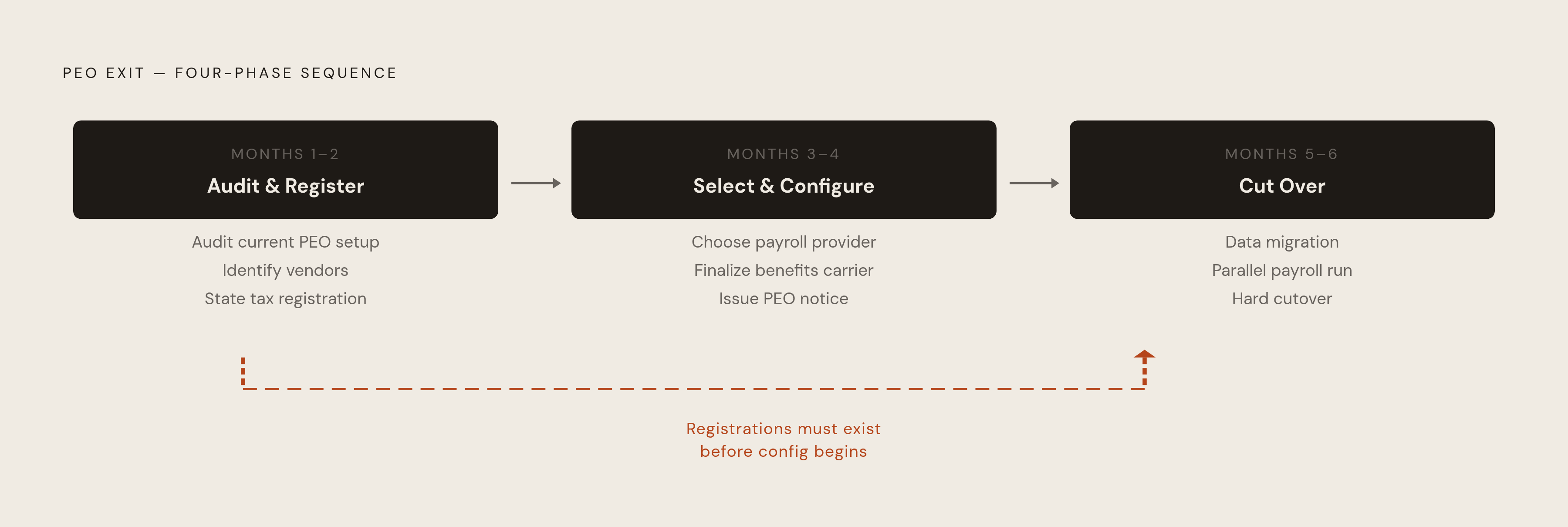
It is the minimum amount of time required to complete several interdependent workstreams, tax account registration, benefits replacement, data extraction, and payroll cutover, none of which can start on day one and none of which can safely run in parallel with each other past a certain point. Newfront's guidance puts four months at the edge of what's possible, but treats six months as the timeline that produces a smooth transition rather than a rushed one.
The outer constraint on the whole project is the notice period written into the contract. Once notice goes out, the co-employment end date is fixed, and everything else has to be finished before that date arrives. Planning has to happen before notice is issued. The first two months are an operating map: auditing what the PEO currently provides, which systems it owns, which tax accounts sit under its EIN, which benefits are active, and what data will eventually need to be extracted, while simultaneously identifying replacement vendors for payroll, benefits, and workers' compensation and starting state tax account registration under the company's own EIN. Months three and four are for locking in those replacements: selecting the standalone payroll provider and beginning configuration, finalizing the benefits carrier and strategy, issuing formal written notice to the PEO under the terms of the contract, and preparing for a parallel run. Months five and six carry out the migration itself: completing data extraction and loading it into the new payroll system, enrolling employees in replacement benefits before PEO coverage lapses, running payroll in parallel where possible ahead of the hard cutover, and communicating every change to employees with enough lead time for them to make benefits elections.
Month three cannot start until month one has produced a completed operating map and initiated state registrations, because the replacement payroll provider cannot configure state tax accounts that do not yet exist, and that sequencing dependency is what makes six months the realistic floor.
Calendar timing adds a final layer. A January 1 cutover is the cleanest option because it aligns with benefits plan years and avoids mid-year W-2 complications, but a mid-year exit is executable as long as the tax account and benefits timelines are respected. A mid-year cutover does mean employees will receive two W-2s for that year, a partial-year form from the PEO under its EIN and a partial-year form from the new payroll provider under the company's own EIN, and employees need to be told about that well in advance so it doesn't cause confusion when tax season arrives.
Setting up state and federal tax accounts under the company's own EIN
Tax account registration is the first major technical workstream, and it has to start earliest because the timeline is controlled by state agencies rather than by the company itself. Under the PEO, every payroll tax obligation, federal income tax withholding, FUTA, SUTA, and state income tax, has been filing under the PEO's own EIN. Once co-employment ends, every one of those obligations has to file under the company's own EIN instead.
For each state where the company has employees, it needs to register a state withholding tax account, a state unemployment insurance account, and any applicable local tax accounts. These timelines cannot be compressed. Some states process registrations in a matter of days, others take weeks, and some require physical paperwork, notarized documents, or an in-state registered agent before they'll issue an account number. Once an account is registered, the company grants its new standalone payroll provider third-party access to manage it, with the company remaining the legal taxpayer of record and the provider acting purely as an agent on its behalf.
Companies with employees spread across multiple states face a multiplying burden, since each state is its own registration project with its own paperwork and its own timeline. The new payroll provider needs every one of those state account numbers before it can run the first payroll correctly, and missing even a single state account results in delayed filings or a payroll run executed incorrectly in that state, either of which creates downstream liability for the company. The practical move at the start of month one is to compile a complete list of every state where employees currently work, including any new hires planned before cutover, and begin every state's registration process simultaneously rather than sequentially. Of every workstream in this playbook, tax account registration is the one most likely to control the actual cutover date, because its timeline belongs to state agencies and cannot be accelerated by better internal project management.
Extracting payroll and HR data cleanly before the PEO closes access
A company's own payroll and HR data does not remain automatically accessible once the PEO relationship ends, and an incomplete extraction creates both an operational failure and a compliance gap with the IRS. Leaving a PEO requires gathering payroll history, benefits enrollment records, employee files, and tax documentation, and some PEOs charge extraction fees or hand the data over in formats that require manual cleanup before anything can be loaded into a new system. IRS guidelines require employers to retain payroll records for at least four years, and the new payroll provider will need a minimum of three years of history to produce accurate year-end W-2s, particularly for a mid-year transition.
The full extraction list runs long: gross wages per employee per pay period, every deduction, pre-tax, post-tax, and garnishment, employer contributions to health, retirement, and HSA accounts, year-to-date tax withholdings broken out by jurisdiction, benefits enrollment records with coverage dates, employee personal information including addresses and dependents, and every tax filing the PEO submitted on the company's behalf. Workers' compensation loss run reports belong on that list too, since they document prior claims history and new carriers require them to underwrite a replacement policy.
PEOs typically limit or cut off data access once the co-employment end date passes, so every data request has to be submitted and fulfilled while the relationship is still active. Some PEOs deliver records in proprietary formats that need manual reformatting before a new payroll system can read them, so that cleanup time needs to be budgeted, and the new provider should be brought in early to confirm what formats it can actually accept. The practical rule is to request every data export as soon as formal notice goes out, typically month three or four, and to assume nothing will be handed over voluntarily beyond what's requested in writing. Companies should get explicit written confirmation from the PEO of what data will be provided and by what date, so there's no ambiguity to dispute once access closes. Data access is a window that closes permanently at the co-employment end date, and nothing extracted after that point can be recovered through negotiation.
Replacing benefits before PEO coverage lapses, with zero gap in employee coverage
Benefits replacement is the most visible workstream to employees, and it carries legal weight: a lapse in coverage of even a single day can trigger COBRA obligations, employer liability, and potential ERISA violations. Under the PEO's master plan, employees are covered as participants in the PEO's own group health arrangement, and that coverage terminates the moment co-employment ends. New coverage must be in force on day one of the standalone arrangement.
Companies leaving a PEO generally have more replacement options than expected. They can negotiate a fully insured group plan directly with a carrier, move to a level-funded or self-funded plan once headcount makes that viable, or adopt an Individual Coverage HRA, where the company sets a fixed monthly allowance and employees use it to buy their own coverage on the individual marketplace, reimbursed tax-free. ICHRA is reportedly the most common path for startups leaving PEOs, with typical allowances running from a few hundred dollars a month per employee for individual coverage up to higher amounts for family tiers.
Health coverage is not the only benefit that needs a replacement plan. Dental and vision are generally straightforward to replace. Life and disability insurance carry carrier-specific underwriting timelines that need to be built into the schedule. Workers' compensation deserves particular attention because it is easy to overlook: PEOs typically carry workers' comp as part of the bundled arrangement, and the company must secure its own standalone policy, underwritten on its own loss history, before the first post-PEO payroll runs. Coverage continuity, more than cost savings or operational convenience, is what employees will remember about how the transition was handled.