Benefits Continuity During a PEO Transition
Ensure workers' comp, payroll, and benefits all align during the shift away from your PEO.

PEO exits have turned into a standard planning event on the HR calendar rather than a rare or fringe move. SHRM projects 2026 as the "Year of the PEO Exit," pointing to rising costs, renewal fatigue, and limited flexibility as the drivers, particularly for companies that have grown past the headcount range where a PEO's math still works in their favor.
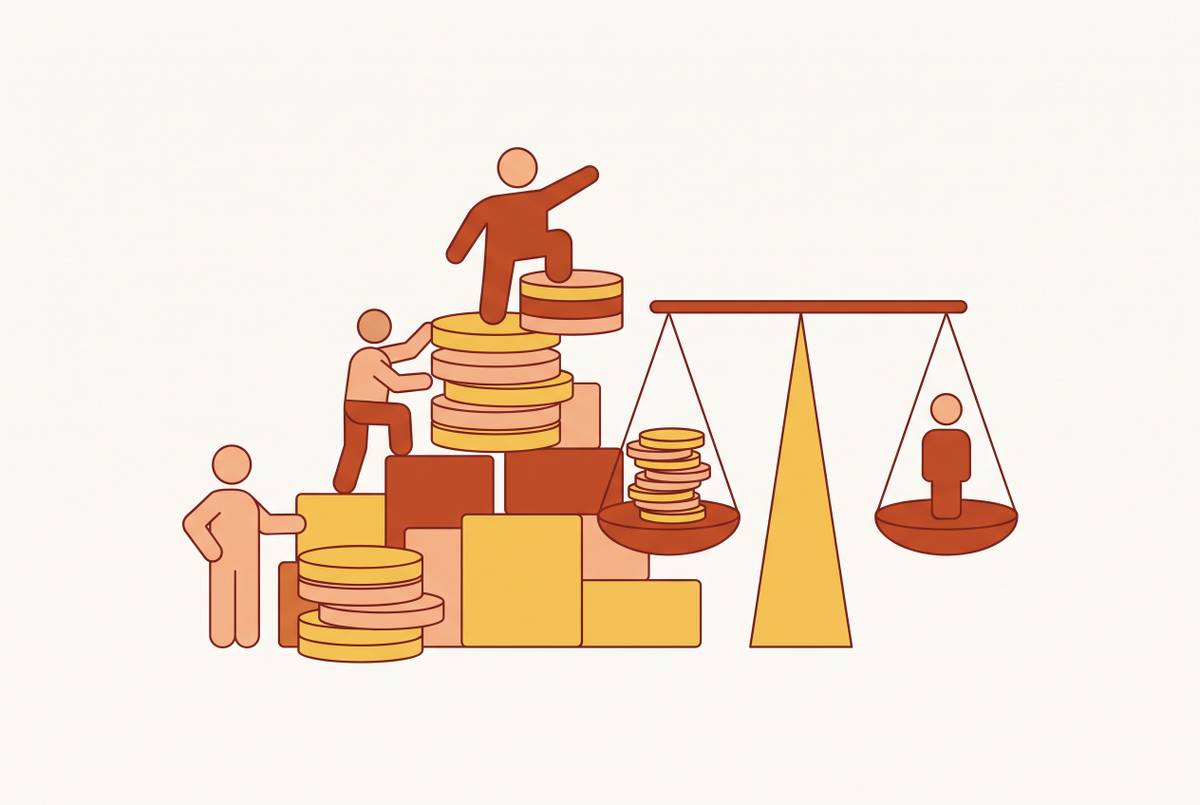
The shift makes sense once you look at how PEO fees are structured. Because the fee scales with total payroll, a company that once got real value from bundled HR, benefits, and compliance support finds that same arrangement turning into a drag on margins as salaries and headcount rise. Nothing about the PEO changed. The company did, and the pricing model didn't keep pace with that change.
What makes the exit itself risky is that coverage, payroll infrastructure, and compliance obligations all shift at once, and a mistake in any one of them tends to compound the others. Workers' comp is a clear example: mid-sized employers exiting a PEO face real risk of a coverage gap opening up mid-transition, and an incident during that gap can create significant uncovered liability. COBRA administration is another. Costs there tend to spike sharply once the process moves from PEO-managed to something the company has to run manually or hand to a new vendorc3. When payroll starts running under the company's own EIN, wage bases reset, which can temporarily reduce take-home pay for higher earners, and companies that don't communicate this in advance risk employee distrust. None of that is dangerous on its own. It becomes dangerous only when employees see a smaller paycheck with no warning and start wondering whether payroll made a mistake.
Every one of these risks has a fix. The fixes only work if someone on the team knows the sequence and the timing well enough to act before the gap opens, not after.
The contract review that controls everything else
F|The PEO contract, not the HR team's calendar preference, sets the exit date. Operators who skip a close read of that contract tend to find out about termination windows, fee obligations, and notice requirements only after they've already told the company a transition date, which is the wrong order to learn those things.
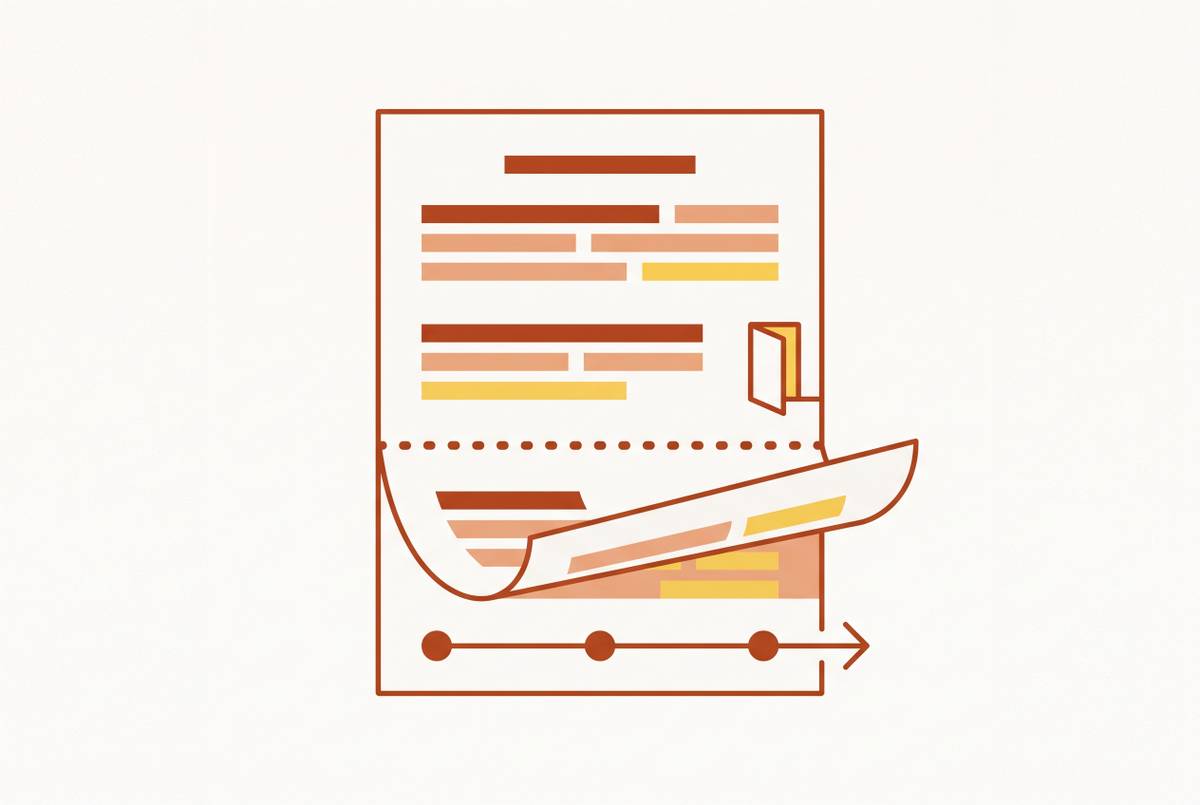
The termination notice period comes first: it's usually measured in weeks or months, and missing it pushes the exit date out, which then cascades into every downstream benefits, payroll, and tax timeline built around that date. Early termination fees come next. Some contracts penalize a mid-year exit outright, and that number needs to sit in the exit budget before the decision gets finalized, not after. Benefits plan ownership clauses matter just as much: the PEO's group health plan ends when the co-employment relationship ends, and the contract spells out the exact termination date along with whatever continuation rights employees are entitled to. Data portability terms round out the list, covering what employee records, claims history, and carrier data the PEO owes the company, in what format, and by what date.
The contract also decides whether the exit actually saves money. A transition that looks like a clear win against gross PEO fees can shrink fast, or flip into a loss, once termination fees, higher COBRA costs, new HRIS subscriptions, and workers' comp setup costs get added in.
For companies not ready for a full break, many PEOs offer an administrative services only arrangement, where the company becomes employer of record and sponsors its own benefits while the PEO keeps running payroll and HR admin. That ASO option belongs in the same contract review, since it can serve as a middle step rather than an all-or-nothing exit.
J|## The case for a January 1 exit date
Leaving on January 1 is the single most effective decision a company can make for benefits continuity during a PEO exit, because a clean year-end break avoids four separate mid-year problems at once, rather than trading one problem for another.
A mid-year exit means employees receive two W-2s (one from the PEO for the co-employment period, one from the company for the remainder), which creates confusion and requires proactive employee communication. Then there's the wage base reset: Social Security and state unemployment wage bases restart once the company begins filing under its own EIN, and for higher earners that means a real, if temporary, dip in take-home pay if nobody explains it in advance. A mid-year exit also breaks the benefits plan year. If the PEO runs a calendar-year plan and the company leaves in, say, September, employees lose coverage mid-year and have to go through a 60-day special enrollment period to actively re-enroll in whatever comes next. ACA compliance reporting covers a fractured plan year, requiring coordination between the PEO's 1094-C/1095-C filings and the company's own; a clean calendar-year exit avoids this split entirely.
Sometimes a mid-year exit is unavoidable, usually because the company is locked into a contract renewal that doesn't line up with the calendar year. In that case, the only real lever is time: build in substantial lead time and a structured plan for communicating the change to employees well before it happens.
The six-month project plan that keeps coverage continuous
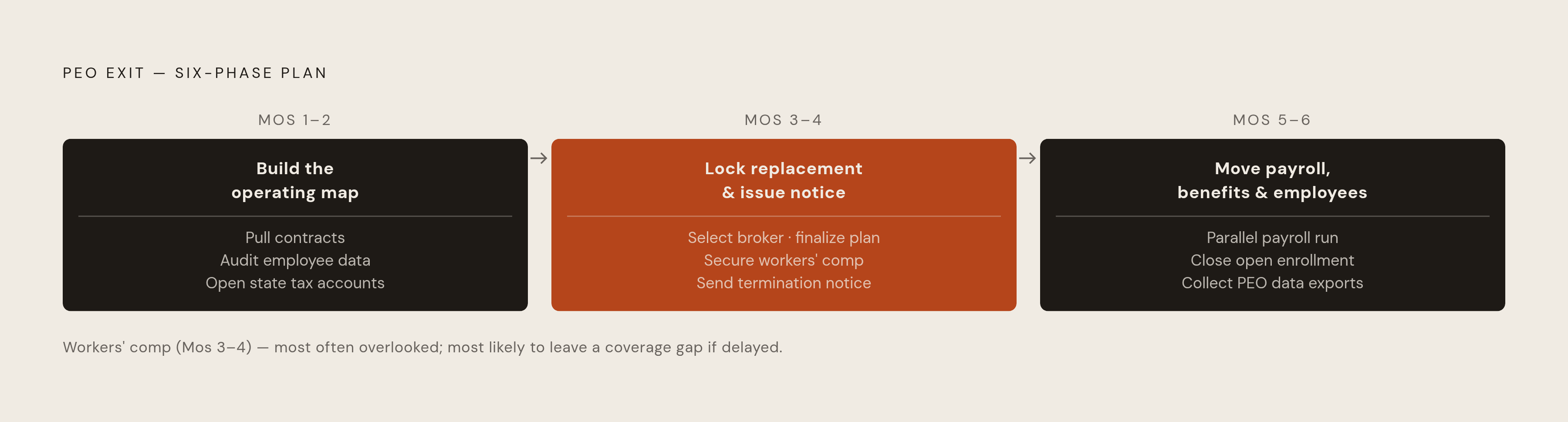
Benefits continuity during a PEO exit is a sequenced project where each step depends on the one before it, and getting the order wrong causes as much damage as skipping a step outright.
Months 1-2 focus on building the operating map. That starts with pulling the contract and extracting the termination window, the notice period, early termination fees, and the benefits plan's termination date. From there, the company needs to audit every piece of employee data it will have to take ownership of: census data, claims history, dependent enrollment, I-9 records, and state withholding authorizations. L|Every state where employees work needs its own tax withholding account, SUI account, and other state-specific payroll accounts under the company's own name, such as California SDI, New York DBL/PFL, New Jersey TDI, or the Washington Cares Fund. This is also the point to start shopping the benefits carrier market, since claims history is what carriers use to price a new plan and getting that data early gives the company real leverage in negotiation.
Months 3-4 focus on locking the replacement and issuing notice. The new benefits broker or AI-native brokerage gets selected, plan design gets finalized, and the carrier effective date gets confirmed against the PEO's plan termination date, with no gap between them. Payroll provider and HRIS selections happen here too, with state registrations confirmed complete before the first payroll run under the new EIN. Formal termination notice goes to the PEO within the contract's notice window, with written confirmation in hand covering both the termination date and the data delivery schedule. A new workers' comp policy gets secured with a start date that matches or precedes the PEO's plan termination date; this step is the one most often overlooked, and it's the one most likely to leave a coverage gap if it slips.
Months 5-6 cover moving payroll, benefits, and employees. B|Payroll should run in parallel for at least one full cycle before cutover, so configuration errors appear in test runs instead of in someone's paycheck. G|Open enrollment for the new plan needs to close before the PEO's plan termination date, and every employee needs to actively enroll, because passive rollover from the old plan isn't an option. Employees need clear communication about what's changing, when, what they need to do, and what the new plan covers, because a 60-day enrollment window only helps if people actually use it. COBRA administration needs to be confirmed and ready for the new plan: federal COBRA kicks in at 20 or more employees, while smaller employers fall under state mini-COBRA laws with their own timelines and notice rules. Last, every data export owed by the PEO needs to be collected and checked for completeness before the termination date, since data retrieval turns into a negotiation once the relationship formally ends.
The compliance obligations that transfer entirely to the employer on day one
The day after a PEO exit closes, every compliance function the PEO used to carry becomes the employer's direct, fiduciary responsibility, and several of those obligations carry steep penalties for filing late or filing wrong.
ACA reporting is the first one to plan for. Applicable Large Employers, those with 50 or more full-time equivalent employees, must file these annually with the IRS to report health coverage offered to full-time employees. Under the PEO, those forms went out under the PEO's EIN. K|Penalties for getting ACA and HIPAA reporting wrong went up for 2026, so the cost of a mistake here is higher than it used to be.
Form 5500 carries its own weight. Welfare benefit plans with 100 or more participants at the start of the plan year generally have to file, though smaller plans may qualify for an exemption if they're unfunded, fully insured, or some mix of both. The deadline lands on the last day of the seventh month after the plan year ends, July 31 for a calendar-year plan, unless an extension gets filed. Missing that deadline is expensive: failing to file on time triggers a penalty that accrues per day starting from the original due date.
COBRA brings its own layer of complexity. Federal COBRA covers employers with 20 or more employees, while smaller employers fall under state mini-COBRA rules that vary by jurisdiction in eligibility windows, notice timelines, and how long continuation coverage runs, and a multi-state employer has to track every one of those variations separately. COBRA administration costs typically spike post-PEO-exit due to the shift from PEO-managed to manual or third-party processing, so that cost belongs in the budget from the start.
Multi-state payroll compliance is the least glamorous of these obligations and arguably the most labor-intensive. Every state where the company has employees needs its own withholding account and SUI account, plus whatever additional accounts apply, SDI, PFL, TDI, or local tax accounts, all of which the PEO had already set up and which now have to be registered from zero. F|States like California, New York, New Jersey, Illinois, and Washington each carry their own overtime rules, mandatory leave contributions, pay transparency requirements, and posting obligations, and those rules change often enough that keeping up with them is a standing task. A compliance calendar that tracks filing deadlines, notice requirements, audits, and renewals stops being optional at this point. It becomes the operational stand-in for the oversight the PEO used to provide without anyone having to think about it.
None of this means every task has to happen in-house. Brokers, payroll vendors, benefits administrators, and insurance carriers can all take on pieces of the administrative load. Fiduciary responsibility for what gets filed, and when, stays with the employer regardless of who's doing the paperwork, and that oversight requirement is the central legal exposure that comes with leaving a PEO.
Designing and pricing the new health plan without starting from zero
Designing the new health plan doesn't have to start with a blank page. The carrier already holding the company's claims history and employee data is the natural starting point for both plan design and rate negotiation, and getting that data out of the PEO is one of the highest-leverage moves in the entire transition.
A|Claims data tells a specific story about whether the exit means worse pricing. Carriers set rates based on actual claims experience, and a company leaving a PEO does lose access to the PEO's pooled risk. A company with a young, healthy workforce may find its own claims history prices better on its own than it did inside the PEO's broader, blended pool. Some platforms built for startups leaving PEOs now surface that claims and employee data directly, so companies can see what their carrier already knows and use it as a negotiating tool rather than treating the pricing process as a black box.
Direct plan sponsorship also opens design choices a PEO's bundled plan never allowed. An ICHRA, where the employer sets a monthly allowance and employees buy coverage on the individual marketplace, fits companies with a distributed, multi-state workforce that a single group plan never served well to begin with. Carrier selection opens up too, since direct sponsorship means shopping across the market instead of accepting whatever the PEO had under contract. Deductible levels, HSA compatibility, dependent tiers, and network choices can all get built around the company's actual workforce rather than a one-size template. None of that flexibility existed inside the PEO relationship. It becomes available the moment the company takes on plan sponsorship directly, and it's the clearest upside of an otherwise demanding transition.