Open Enrollment Timeline and Checklist for Employer-Sponsored Plans
Start your open enrollment planning 90 days ahead to lock in savings.

Open enrollment is decided roughly 90 days before it opens, not during the enrollment window itself. By the time employees are logging into a portal to make elections, the plan options available to them, the carrier terms behind those options, and the compliance posture of the whole program are already locked in. A 30-day runway does not leave enough time to go to market for competing quotes, weigh a different plan structure against the current one, and work through the federal compliance steps that have to be confirmed before enrollment materials go out. Each of those tasks takes real calendar time on its own, and they cannot be compressed into a single month without cutting corners somewhere.
Employer-sponsored open enrollment works differently from ACA marketplace enrollment or Medicare enrollment, both of which run on federally set calendars. A company chooses its own open enrollment dates, and most run enrollment in October or November to land a January 1 effective date, but nothing in federal law requires that timing. The pressure employers feel every fall is self-imposed, built from habit and calendar convention. That matters because it means the 90-day runway is also self-imposed: an employer that starts the process late has nobody to blame but its own calendar.
The cost of starting late is not neutral. An employer that runs out of runway and lets the current carrier's renewal terms stand by default has given up any savings that a competitive bid process or a plan redesign might have delivered. That forfeited saving is invisible on any line item, which is part of why it's so easy to miss, but it compounds every year the same pattern repeats.
What employers are up against when costs are rising every renewal cycle
Healthcare cost trends are rising fast enough that treating renewal as a formality locks in a cost increase that compounds. The gap between what a passive renewal costs and what an actively managed one costs grows wider each cycle, because an employer that never benchmarks or renegotiates is stacking one year's unmanaged increase on top of the last.
That's the real argument for the 90-day timeline. Employers who benchmark their plan and renegotiate with carriers at every renewal are capturing savings that employers who default to the incumbent's terms are giving up permanently. Those savings do not carry forward if skipped. A missed benchmarking cycle is not deferred to next year; it's gone, replaced by a baseline that's already higher than it needed to be.
The 90-to-60-day phase: benchmarking, carrier shopping, and plan-type evaluation
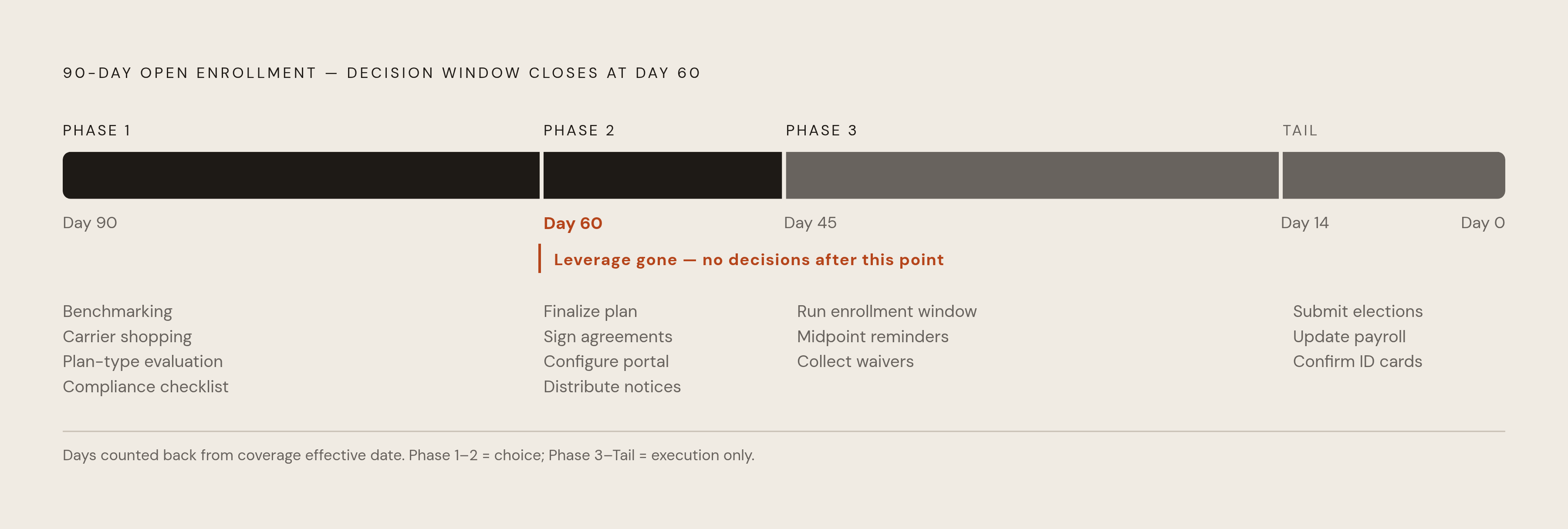
The first 30 days of the 90-day runway, from 90 days out to 60 days out, is the only window in which an employer can build a genuinely competitive renewal. This is when claims data gets pulled, carriers get shopped, and the question of whether the current plan structure even fits the workforce gets asked seriously.
The work starts with the employer's own numbers. If you pull prior-year claims data and request a renewal proposal from the current carrier, you get a baseline, a number to measure every other option against. Without that baseline, there's no way to tell whether a competing quote is actually better or just differently structured.
From there, the broker or benefits advisor should be shopping the renewal across a broad set of carriers, not just collecting a single quote from the incumbent and calling it market-tested. A renewal number from one carrier, taken in isolation, tells an employer almost nothing about whether that number is competitive. It takes multiple quotes, pulled from multiple carriers, to know where the market actually sits.
This phase is also when plan-type alternatives deserve a real look, not just a passing mention. The 90-day mark is when that comparison needs to happen, while there's still time to switch funding structures if the numbers support it, not after the renewal paperwork is already signed and the window for changing course has closed.
Plan design itself deserves the same scrutiny. Deductible levels, cost-sharing structure, and network breadth all affect both cost and employee satisfaction, so none of them should be inherited from the prior year without checking them against what comparable employers in the same industry and region are offering.
The 90-to-60-day compliance checklist: ACA, ERISA, and COBRA obligations that must be confirmed before enrollment opens
Compliance confirmation runs on the same clock as benchmarking, and several federal obligations carry specific deadlines or updated thresholds for 2026 plan years that you need to check before enrollment materials are finalized.
Applicable Large Employers need to confirm that at least one health plan offered to full-time employees meets the ACA affordability standard. The affordability percentage for plan years beginning in 2026 is 9.96%, a meaningful jump from 2025 and the highest that percentage has ever been. That increase gives ALEs some room to raise employee contribution amounts while staying compliant, which is worth factoring into plan design conversations happening during this same window.
Non-grandfathered health plans also need to comply with updated ACA out-of-pocket maximums for plan years beginning on or after January 1, 2026, and plan documents need to reflect those limits before enrollment opens, not after the fact.
HSA and HDHP limits are increasing for 2026 as well: HSA contribution limits are going up, and so are the minimum deductibles and out-of-pocket maximums that define a qualifying HDHP.
ERISA obligations apply regardless of company size. There's no small-employer exemption from ERISA itself, so a company with a handful of employees and a group health plan carries the same core obligations as a much larger employer, including distributing Summary Plan Descriptions to new participants within a set window after their coverage begins and meeting fiduciary duties of prudence and loyalty in every decision made about the plan.
COBRA applies to employers with 20 or more employees, and plan administrators need to provide an initial COBRA notice to new participants and certain dependents within a set period after coverage begins.
Preventive care coverage rules round out the list. Non-grandfathered plans need to adjust first-dollar preventive care coverage to reflect the latest recommendations, and coverage for a newly recommended service generally needs to be in place for plan years beginning on or after the one-year anniversary of that recommendation. You need to confirm the current plan design reflects the most recent guidance before enrollment materials go final.
The required notices that must accompany every open enrollment
Federal law requires a specific set of notices to reach participants at or before every open enrollment, and each one carries its own penalty for non-compliance, so none of them can be satisfied by bundling them into some other document and hoping it covers the requirement.
The Summary of Benefits and Coverage has to go to every benefit-eligible employee at open enrollment, specifically when employees are being asked to make an affirmative benefit election, and failing to provide it carries a significant penalty for each failure. The COBRA General Rights Notice has to reach new plan participants, and if you fall short here, a per-day penalty accrues the longer the gap goes unaddressed. The Medicare Part D Creditable Coverage Notice has to reach every Medicare-eligible participant and dependent before October 15 each year, and that date doesn't move regardless of when the employer's own open enrollment falls. The ERISA Annual Report, Form 5500, carries a significant per-day penalty if plan sizes required to file don't file.
Employers should confirm every one of these notices is present in the open enrollment materials being distributed, and bundling them into a single enrollment packet cuts down on administrative overhead while creating one clear record that each notice went out.
The 60-to-45-day phase: finalizing plan selection and configuring enrollment
By 60 days out, the benchmarking work from the first phase needs to turn into decisions. Plan selection gets finalized, carrier agreements get signed, and then whatever negotiating leverage existed earlier in the process is gone. Anything that happens after this point is administrative work, executing a decision already made, not a chance to change the decision itself.
The SBC and other plan documents need updating to reflect 2026 limits and whatever design changes were decided on, and that update has to happen before the SBC is distributed to employees, not fixed afterward once someone notices the numbers are wrong. The enrollment portal or platform needs configuring too: plan options, contribution amounts, and dependent-eligibility rules all need to match the final plan design, and the employee-facing side of that system needs testing before it goes live, so employees aren't the ones discovering a broken dropdown menu or a missing plan tier.
Employee communications also take shape in this window: plan comparison materials, FAQs, and a clear explanation of what changed from the prior year. Employees who understand what's different are far more likely to make an active, informed choice rather than letting their prior election carry forward by default.
This is also the right moment for a dependent eligibility audit, if one is overdue. If you run the audit before enrollment opens, ineligible dependents can't simply be re-enrolled for another plan year without anyone checking. It's a standard pre-enrollment step at this point, not some unusual extra measure reserved for employers with a known problem.
The 45-to-14-day phase: running the enrollment window and reaching every employee
The enrollment window itself needs to be long enough for employees to make a deliberate decision and structured enough that anyone who hasn't enrolled gets identified and followed up with before the deadline passes, not after. Most benefits professionals recommend a minimum of two to four weeks for the open enrollment window, and if you're making significant plan changes, you should lean toward three weeks. If the window is shorter, employees are more likely to miss the deadline entirely or rush through a decision under time pressure without really understanding what they're choosing.
The window should open with a clear communication that lays out what changed, when the deadline is, and where to go for help. Benefits meetings or recorded walkthroughs, live or asynchronous, give employees an actual explanation of their options, and employees who get that explanation tend to make more cost-effective choices and generate fewer support requests once enrollment closes.
This matters because most employer plans default to auto-renewal if an employee takes no action, carrying forward whatever election was in place the prior year. That default is not a safe one. Active communication during the enrollment window is the employer's best tool for catching those mismatches before they turn into a January surprise.
At the midpoint of the window, a reminder should go out to everyone who hasn't yet made an election, and that follow-up works best when it's targeted at the specific people who haven't enrolled rather than broadcast to the whole company regardless of status. An undocumented waiver is a compliance gap waiting to surface later.
Elections, payroll, and ID card confirmation after enrollment closes
The two weeks between enrollment closing and the plan's effective date carry their own risk of error, and it's a narrow window where payroll deductions, carrier submissions, and ID card delivery all need to line up. Any gap here becomes a coverage failure on January 1, exactly when employees are trying to use the benefits they just signed up for.
Final elections need to go to carriers promptly once enrollment closes. Payroll deductions need updating to match the new plan year's employee contribution amounts, because deductions still running on the prior year's numbers create overpayments or underpayments that take real administrative effort to untangle later.
ID card delivery timelines need confirming with each carrier, and employees need to know when to expect their cards along with a clear path to escalate if the cards haven't arrived by the effective date. Finally, the whole enrollment cycle needs documenting: a record of the elections made, the waivers collected, and the notices distributed. That record becomes the employer's defense if a compliance review or an employee dispute comes up later.
The broker or advisor relationship's role in whether the 90-day process produces real savings or just completed paperwork
A 90-day timeline filled with the right tasks only produces savings if the advisor running it actually wants a better deal every year, rather than wanting to keep the current carrier relationship in place. The timeline itself is just a structure. Whether it produces a lower-cost plan or just a well-documented repeat of last year's terms depends almost entirely on who's executing it.
Traditional broker compensation is commission-based, paid by carriers, and that structure tends to favor inertia: an advisor who doesn't actively shop the market every single year isn't doing anything to push back against the cost escalation described earlier in this piece. The benchmarking and carrier-shopping work covered in the 90-to-60-day phase only happens if the advisor treats every renewal as a competitive event worth fighting for, rather than a formality to ratify whatever the incumbent carrier proposes.
Newer tools are changing what's possible here. AI-powered plan analysis can evaluate a workforce's claims data alongside carrier pricing, so employers get direct visibility into whether their current plan design and carrier selection are actually competitive, instead of leaving that judgment entirely to one advisor's say-so.
The advisor relationship matters past the enrollment window too. Employees need support throughout the year, not just during the enrollment period, and round-the-clock access to help understanding and using their benefits takes real pressure off HR while improving how much employees actually get out of the benefits the employer is already paying for. Compliance monitoring across ACA, ERISA, COBRA, and state-specific rules works the same way: it's a continuous responsibility, not a once-a-year checklist, and an advisor who treats it as an annual exercise leaves the employer carrying exposure in the gaps between renewal cycles.
The real question for an employer is whether the specific advisor relationship in place will execute the full 90-day process at the standard this timeline demands, every single year, without needing a reminder.