Health Insurance Benchmarking for Tech Startups by Headcount Band
Startups' health insurance options shift dramatically as they grow past each hiring threshold.

A renewal quote lands in a founder's inbox and the number is substantially higher than last year, with no explanation beyond "market conditions. A candidate turns down an offer because the benefits package looks thin next to a competing offer from a company twice the size. Both moments trace back to the same cause: headcount, not preference or industry norm, is what determines which health insurance products a startup can even buy. A five-person team and a fifty-person team are not choosing between the same menu of options at different prices. They are choosing from different menus entirely, because group carriers need enough enrolled lives to price a group's risk with any confidence, and a startup below that threshold often cannot buy a traditional group plan on reasonable terms no matter how much it is willing to pay. Three questions change shape at every headcount band: what funding structure makes sense (fully insured, level-funded, or self-funded), what employer contribution counts as competitive, and whether a PEO's pooling advantage still outweighs the control a company gives up to get it. The sections that follow map those questions against four headcount bands, because benchmarking a contribution rate or a plan design only means something when it's measured against the right comparison group.
The four headcount bands
Four headcount thresholds mark real shifts in what a startup can buy, what it must comply with, and what "competitive" looks like against peers at the same size, not administrative categories someone invented for a spreadsheet.
At the smallest band, group carriers are frequently unwilling to write a policy at all, or will do so only on terms that make little financial sense for the employer. Reimbursement-based arrangements tend to be the most workable path in, because neither carries an employer-size restriction and both convert an unpredictable claims pool into a fixed, defined contribution. Under an ICHRA, the employer sets a reimbursement budget, and employees use it to buy individual marketplace coverage, so the employer gets cost certainty and skips the actuarial baggage of insuring a tiny group. At this band, there's no Applicable Large Employer obligation and no Form 5500 requirement, so the compliance surface is about as light as it ever gets.
Once a company grows past that earliest stage, group plans and HRAs both become real options, and the right call depends on workforce demographics and on how much the company needs a predictable monthly cash outlay. Level-funded plans start to show up here as a middle path: the employer pays a fixed monthly amount that includes stop-loss protection, avoiding both the premium unpredictability of a fully-insured renewal and the claims risk of going fully self-funded. A 30-person standalone group often cannot access the large-group carrier rates and plan designs that a PEO's combined pool makes available, making this the band where PEO pooling tends to deliver the most value. The company still sits below the ALE line, so there's no shared-responsibility payment exposure, but ERISA's document requirements, the written plan document, the Summary Plan Description, timely notices, apply to every private-sector plan sponsor regardless of size.
If a company crosses 50 full-time employees (counted together with full-time equivalents), it becomes an Applicable Large Employer under the ACA, and that status changes the stakes of every plan design decision made afterward. The employer must now offer affordable, minimum-essential coverage to a substantial majority of its full-time workforce or risk a shared-responsibility payment from the IRS. PEO economics start to soften here too: per-employee-per-month fees compound as headcount rises, and the company now has enough of its own claims data to start conversations directly with carriers. Level-funded arrangements become considerably more attractive at this size, because an employer's claims experience is finally large enough for a stop-loss carrier to price with confidence. Employer contribution levels stop being a line item on a budget spreadsheet and start functioning as a recruiting tool, because candidates at this stage are routinely comparing offer letters across several companies at once.
At 100 or more employees, the Form 5500 filing obligation takes effect for any plan with 100 or more covered participants on the first day of the plan year, a distinct compliance trigger from the ALE threshold that gets conflated with it more often than it should. Self-funded arrangements become viable for employers with enough claims volume to carry their own risk, backed by stop-loss insurance. A dedicated broker relationship or in-house benefits staff stops being optional, because the compliance surface at this size is too wide for a generalist HR manager to carry alone. Plan design choices that would have been unaffordable earlier, tiered networks, reference-based pricing, pharmacy or behavioral health carve-outs, are now cost-justified by the size of the premium base they operate against.
(A table mapping the four bands against funding structure, PEO fit, and compliance trigger would serve readers well here.)
What "competitive" means in each band: contribution rates, plan types, and funding structures
Benchmarking only works when the comparison set matches a company's actual band. A 25-person startup measuring its contribution rate against a 200-person company's benchmark is comparing itself to a company operating under a completely different set of rules and options, and the result will look wrong no matter what the 25-person company actually does.
At the smallest band, the right benchmark isn't a premium percentage at all, since there often isn't a group premium to measure against. What matters is whether the ICHRA or QSEHRA allowance is large enough to actually cover a meaningful individual plan in the employee's own market. Contribution adequacy depends heavily on geography: an allowance that covers a solid silver-tier plan in Austin will fall well short of covering the same tier of plan in San Francisco. Any benchmark at this band has to be local, not a national average, or it will systematically understate what employees in expensive metro markets actually need.
In the small-but-growing band, the benchmark shifts to group plan structure: the mix of HMO, PPO, and HDHP-plus-HSA offerings, employer contribution as a share of single and family premium, and whether the company offers a second plan option. Startups competing for engineering and sales talent are working against a labor market where candidates increasingly expect richer benefits as a baseline, not a perk. HDHP-plus-HSA combinations tend to appeal to younger, healthier workforces that want to keep premiums low and build HSA balances, but if the workforce includes employees with families or ongoing care needs, a high-deductible plan handles those poorly, so PPO options become close to necessary. Level-funded plans are gaining ground quickly in this band for another reason beyond cost control: some arrangements let the employer share surplus savings with employees when claims come in under projection, a detail that can function as a real recruiting differentiator.
Once a company crosses into ALE status, contribution benchmarking gets sharper because the IRS now has an explicit view on what counts as affordable. The employer's contribution toward employee-only coverage has to meet the ACA's affordability threshold or the company risks a penalty, which makes the employee-only tier the one contribution number every ALE has to get right. Family coverage is a different story: the ACA's affordability standard doesn't govern what employers contribute toward dependent coverage, and that distinction trips up a lot of employers who assume the same rule applies across the board. The practical result of that misunderstanding is underinvestment in family coverage, which tends to cost employers candidates and employees with families when a competitor offers a more generous dependent contribution. Plan design at this band should generally include at least two options, typically a high-deductible plan alongside a richer PPO or EPO, so employees get a real choice but the risk pool doesn't split so thin that neither plan prices well.
At 100 or more employees, the comparison set changes almost completely. For employers running self-funded arrangements, premium rates stop being the relevant number; what matters now is claims cost per member per month, stop-loss attachment points, and administrative cost per employee. Pharmacy carve-outs, reference-based pricing, and direct primary care arrangements become cost levers that are actuarially defensible at this scale in a way they simply aren't for a 40-person company. Mental health parity compliance, named as a federal enforcement priority for the coming year, has become a real plan design consideration at this size.
Why PEO economics invert as headcount grows
The single most consequential infrastructure decision a startup in the 20-to-100 headcount range makes is whether to stay inside a PEO or build its own benefits stack, and the right answer depends entirely on where the company sits in that range.
A 15-person startup placed inside a PEO's pooled group gets access to large-group carrier rates and plan designs built for a pool of tens of thousands of employees, access that company would never get negotiating on its own. That's genuine, measurable value, and it's the reason PEOs exist as a category. But the same pooling that delivers that value also sets a ceiling on what the company can do with its own benefits program. A company inside a PEO cannot design its own plan, cannot pick carriers outside the PEO's existing lineup, and cannot use its own claims experience to negotiate a better renewal, even once that claims experience becomes detailed enough to matter to an underwriter.
Per-employee-per-month fees scale with headcount, and a fee structure that was barely noticeable at 15 employees becomes a significant line item once the company reaches a meaningful scale, one that now competes directly against the cost of hiring a dedicated HR person and building a direct broker relationship instead. By the upper end of the mid-size range, most companies have accumulated enough claims history to start direct conversations with carriers on their own, and that's exactly the moment the PEO's pooling advantage starts to matter less, because the company no longer needs someone else's pool to get a credible quote. What a PEO costs a growing company in control, over plan design and carrier choice, stops being an obvious bargain once the company has outgrown the reason it joined.
A common objection to leaving a PEO is that the PEO bundles HR, payroll, and compliance functions alongside benefits, so exiting means replacing an entire operating system, not swapping out one insurance plan. That's a fair concern, but it overstates the difficulty. Targeted outsourcing, COBRA administration, ACA reporting, leave management handled by specialized vendors rather than a single bundled provider, can replace those individual functions at a lower total cost than the PEO's bundled PEPM fee, and without the co-employment relationship a PEO requires.
Reading the true cost of a PEO exit
Most founders modeling a PEO exit make the same mistake: they compare the PEO's monthly invoice against a replacement quote from a broker or HRIS vendor and treat the gap between those two numbers as the savings. The real cost of an exit includes transition fees, internal labor, and compliance risk, none of which appear in either quote.
Start with the contract itself. PEO agreements typically run 12 months with auto-renewal clauses built in, and terminating early can trigger penalties substantial enough to erase months of projected savings before the new system has even run its first payroll cycle. Layered on top of that penalty are the direct transition costs: a termination fee, the setup cost for a new HRIS and payroll platform, and whatever a new broker charges to stand up the arrangement. Each of those is a real cash outlay, and each belongs in the exit model as its own line, not folded into a vague "transition costs" estimate.
Internal labor gets left out of these models more often than any other cost. HR, payroll, finance, and IT staff all spend real time on a PEO migration, and that time is a genuine cost buried in the salary the company was already paying. A founder who doesn't account for that labor is comparing the new structure's cash cost against the PEO's all-in cost, which flatters the exit decision in a way the math doesn't support.
Compliance risk is the part of this model that's hardest to price and easiest to underestimate. Workers' compensation coverage gaps during a transition are a documented exposure when a company moves off a PEO's master policy. COBRA administration errors, specifically missed election notices, carry a penalty of $110 per day per qualified beneficiary, and a rushed cutover is exactly the kind of process failure that produces missed notices. Benefits continuity is the risk employees will notice fastest: a mid-year carrier change can disrupt claims already in progress, interrupt ongoing treatment authorizations, and scramble HSA contribution schedules employees were relying on.
Timeline matters as much as any single cost line. Six months is the runway that allows for a smooth transition, with enough time for parallel testing between the old and new systems before the cutover. Four months is achievable, but it compresses that testing and parallel-run period in ways that raise the odds of something breaking during the handoff.
The right decision model weighs the total first-year cost of the new structure, broker fees, HRIS costs, HR labor, and transition costs, against the total first-year cost of staying inside the PEO, with one more line item added for the option value of negotiating directly with carriers in year two. That last line is easy to skip and probably the most important one in the whole model, since it captures value in year two that a first-year comparison does not measure.
Compliance obligations that activate at each headcount milestone
The headcount thresholds that run through this article aren't informal industry conventions. Each one is a specific, legally enforced line with a published penalty attached to crossing it without complying.
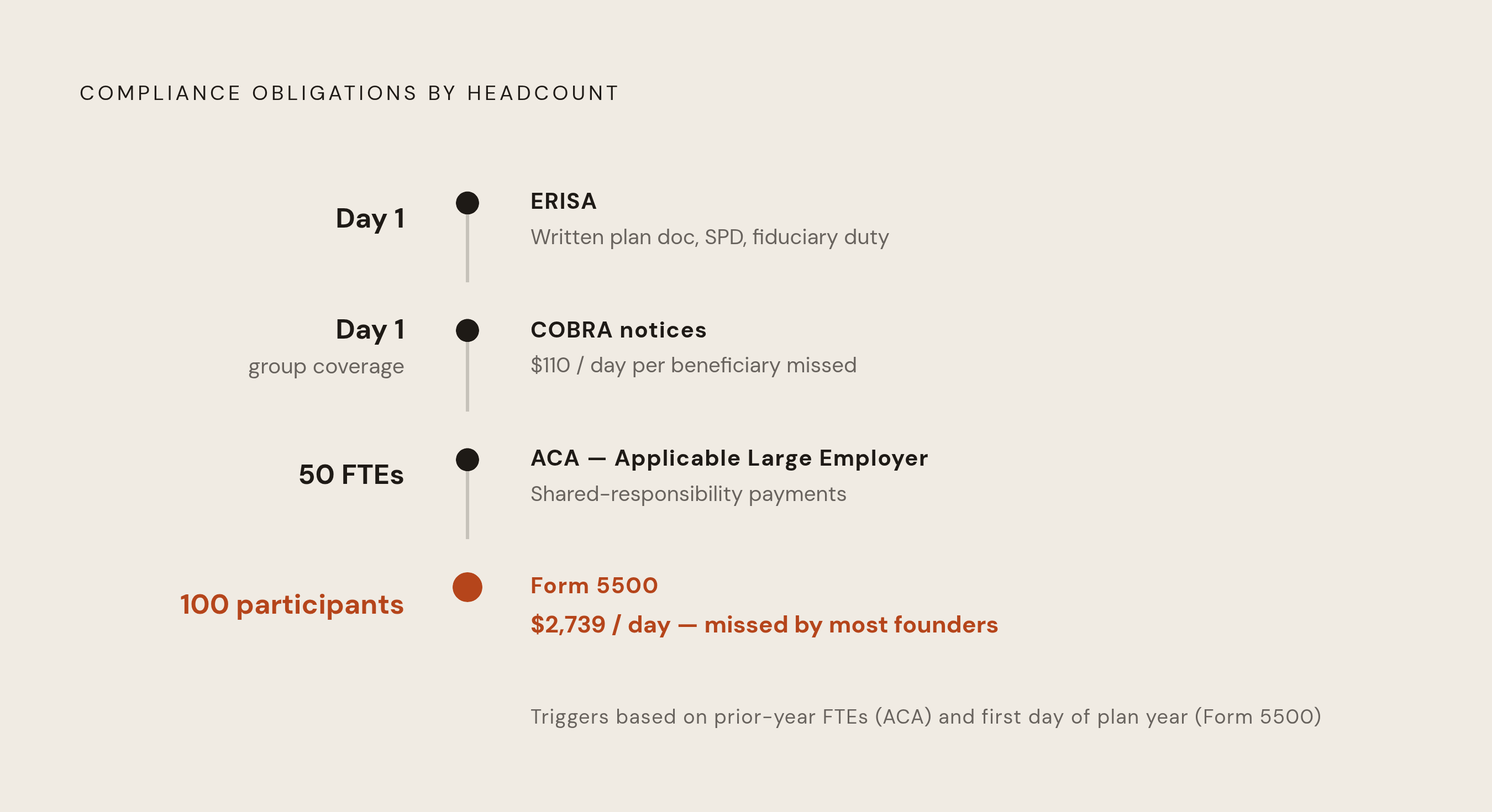
ERISA's obligations apply from the first day a company sponsors a group health plan, no matter its size. A written plan document and a Summary Plan Description are required, notices have to be delivered on time, and fiduciary standards govern how the plan is administered. None of that depends on reaching 50 employees. It applies to a small startup exactly as it applies to a much larger company.
The ALE threshold activates at 50 full-time employees, counted together with full-time equivalents calculated against the prior calendar year. Once a company crosses that line, it must offer affordable, minimum-essential coverage to a substantial majority of its full-time workforce or face a shared-responsibility payment from the IRS, and the affordability standard driving that obligation ties directly back to the employer contribution benchmark discussed earlier.
Form 5500 filing activates separately, at 100 covered plan participants on the first day of the plan year. For calendar-year plans, the filing deadline falls on July 31 of the following year. Missing that deadline triggers a penalty of $2,739 per day, counted from the date the filing was originally due, a number steep enough that a few weeks of oversight can turn into a serious liability.
COBRA notice obligations apply to every covered employer that offers group health coverage, no matter its ALE status. A general notice is due shortly after an employee enrolls in the plan, and an election notice is due within a short window following a qualifying event, with the same $110-per-day penalty for missed election notices that applies during a rushed PEO transition. These triggers accumulate as a company grows, each with its own clock and its own penalty, and a founder tracking only the ALE threshold while ignoring Form 5500 and COBRA timing is tracking exactly one-third of the actual compliance picture.