ACA Employer Shared Responsibility for Companies Approaching 50 Employees
ALE status hinges on prior-year workforce math, not current headcount.
ACA Employer Shared Responsibility for companies approaching 50 employees depends on a prior-year workforce calculation. Preparation requires monthly employee-hour records, compliant coverage offers, and separate reporting controls. For a workforce spread across jurisdictions, automated benefits compliance monitoring should track state reporting requirements as well as federal ACA deadlines.
Why the 50-employee threshold is a backward-looking workforce math problem, not a calendar milestone
Waiting until the company reaches 50 employees assumes that the duty to comply starts as soon as that hire is made. The statute works in the opposite direction. Under IRS ALE determination guidance, Applicable Large Employer status is based on the average number of full-time employees and full-time equivalents in the previous calendar year. Last year’s workforce may therefore have already determined this year’s obligations, even if current headcount is lower.
That distinction changes the planning window for a growing company. An employer that expanded quickly and then paused hiring cannot use the pause to suspend obligations established by its prior-year average. Slower hiring creates no automatic grace period. Conversely, a single month above the threshold does not by itself establish ALE status, because the governing calculation averages the monthly totals. The significance of the payroll roster first displaying 50 names depends on what the entire year’s workforce arithmetic establishes.
How the full-time equivalent calculation works, and why a headcount of 40 can still make you an ALE
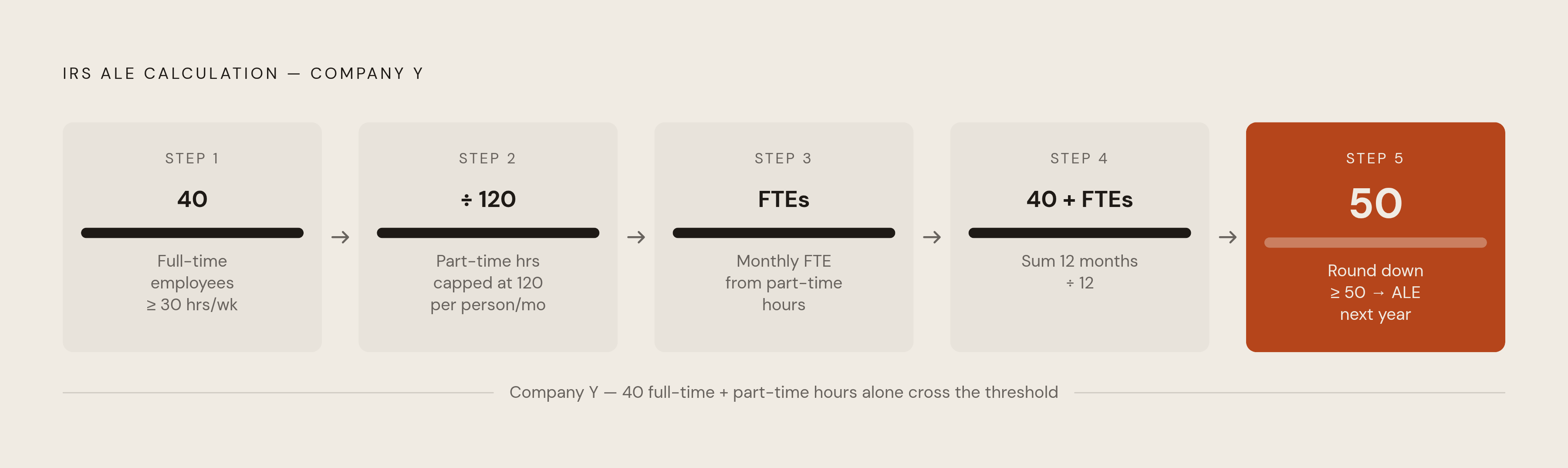
The payroll roster also understates the calculation when operators count only full-time employees. IRS rules define a full-time employee as someone averaging at least 30 hours of service per week or 130 hours per calendar month. For each month, the employer combines hours of service for non-full-time employees, caps each individual’s contribution at 120 hours, and divides the total by 120 to obtain full-time equivalents.
The employer then adds each month’s full-time employee count and FTE count, sums the monthly totals, and divides by 12. The employer rounds the annual result down to the nearest whole number. IRS guidance illustrates the distinction through Company Y, which has 40 full-time employees and enough part-time hours to bring its annual average to exactly 50. Company Y is consequently an ALE for the following year, despite having fewer than 50 full-time employees.
Once an employer becomes an ALE, the employer shared responsibility rules do not require offers to part-time employees, and a part-time employee’s Marketplace subsidy cannot trigger a penalty. Related entities require a different adjustment because the controlled-group rule aggregates employees under common ownership before testing the threshold. Seasonal staffing may qualify for a narrow exception, but the employer needs records that show why the work counts as seasonal, since calling a busy period temporary is not enough.
What ALE status actually requires: the coverage offer, affordability, and minimum value rules
An ALE must offer minimum essential coverage to at least 95% of its full-time employees and their dependent children up to age 26, or risk the first penalty tier. The dependent definition is specific. It includes legally adopted children and children placed for adoption, but excludes stepchildren, foster children, and spouses. An employer’s benefit design therefore needs to distinguish the ACA offer requirement from any broader family coverage it chooses to provide.
The plan must also provide minimum value by covering a substantial share of expected healthcare costs for a standard population and providing substantial inpatient and physician coverage. Affordability is a separate test applied to the employee’s required contribution for the lowest-cost self-only plan that provides minimum value. A plan’s benefits and its employee price must therefore be assessed independently.
IRS affordability safe harbors let employers use that price test without having to get actual household income. They include methods based on W-2 wages, rate-of-pay, and the federal poverty line. For 2026, the affordability percentage is 9.96%. The increase makes employee contribution pricing a live renewal decision rather than a figure that can simply be carried forward from an earlier plan year.
The two penalty tiers, how they are triggered differently, and what a 50-person company actually owes
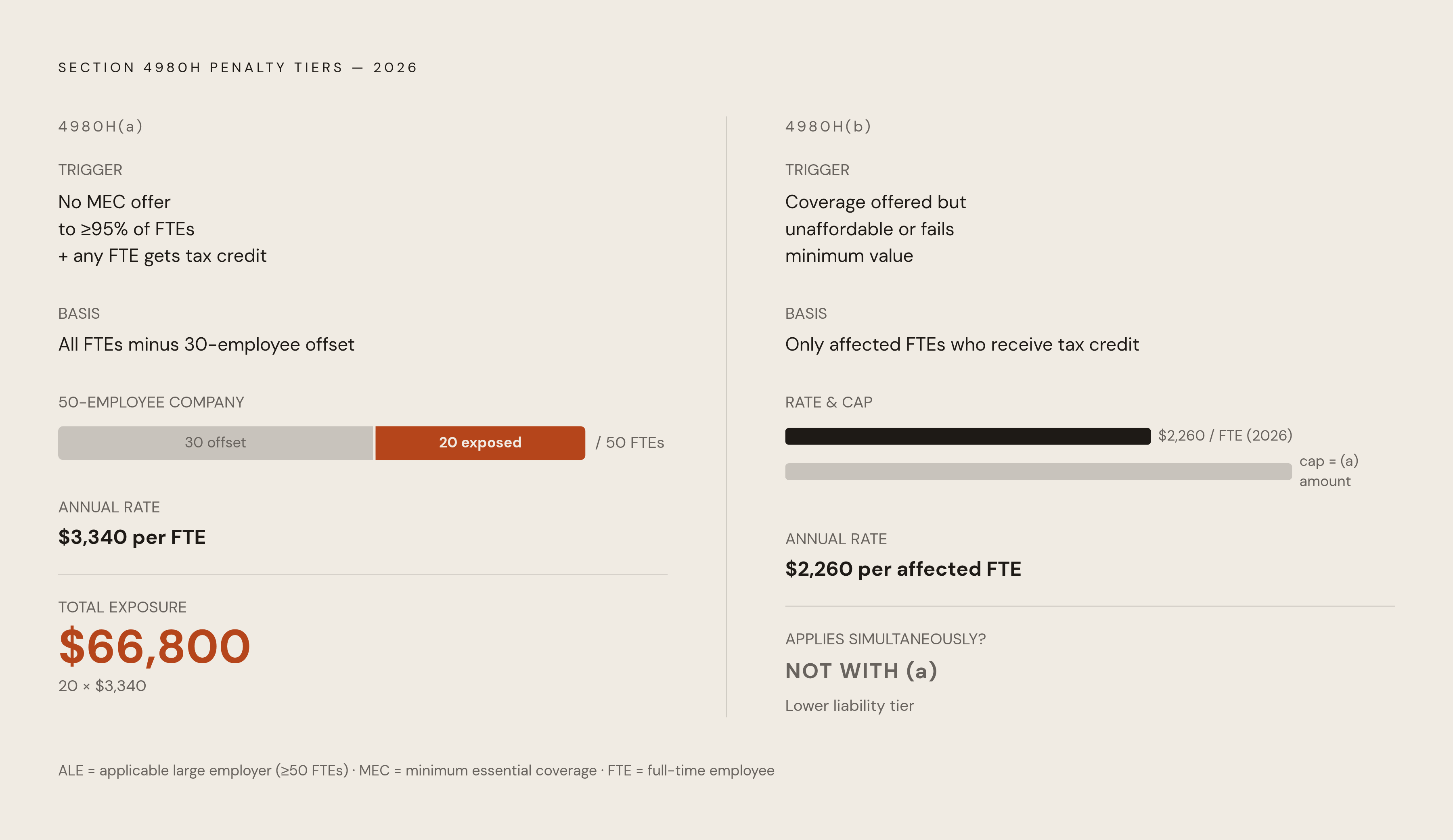
The two employer shared responsibility payment tiers have different triggers and different assessment bases. They do not apply simultaneously. Section 4980H(a), the no-offer penalty, can apply when an ALE fails to offer minimum essential coverage to the required percentage of full-time employees and dependents, and at least one full-time employee receives a Marketplace premium tax credit. That employee’s credit can expose the broader full-time workforce to the assessment.
For 2026, the annual no-offer penalty is $3,340 per full-time employee after a 30-employee offset. For a company with exactly 50 full-time employees, no coverage offer, and a qualifying Marketplace subsidy, the annual assessment applies to the full-time workforce remaining after the 30-employee offset. The liability is non-deductible.
Section 4980H(b), the inadequate-offer penalty, instead applies to affected full-time employees who receive a Marketplace tax credit when the offered coverage is unaffordable or fails minimum value. Its scope is narrower than the no-offer assessment. The IRS applies a per-affected-employee amount, capped at what the employer would owe under the no-offer tier. An offer that clears the broad coverage threshold can therefore reduce exposure even when it has deficiencies, although those deficiencies still create penalty risk.
The Employer Reporting Improvement Act, signed December 23, 2024, established a six-year statute of limitations for returns due after December 31, 2024, replacing the prior absence of a fixed assessment window. The IRS has issued penalty notices for tax years dating to 2015. Retain the records needed to explain earlier coverage offers as well as the current plan.
The IRS reporting obligations that run alongside the coverage mandate and what getting them wrong costs
ALEs must report offers to the IRS and furnish information to full-time employees, with separate deadlines and penalty exposure for reporting failures. Form 1095-C shows the coverage offer made to an employee, the lowest-cost premium, and any safe harbor or relief codes that apply. Part III reports enrollment details for self-insured plans only, while Form 1094-C transmits the batch of employee forms and summarizes the employer’s coverage offer.
For the 2026 tax year, the paper filing deadline for Forms 1094-C and 1095-C is March 1, 2027, and the electronic filing deadline is March 31, 2027. IRS draft 2026 instructions set March 2, 2027, as the deadline to furnish Form 1095-C to applicable full-time employees. These dates require separate tracking. Form 8809 allows an automatic 30-day extension for IRS filing, but that extension does not extend the employee-furnishing deadline.
Some states and jurisdictions have their own health coverage reporting requirements, so employers may still have filings to complete after they finish the federal ones. Multi-state employers must check those requirements on their own. A mid-year departure from a professional employer organization adds a data-continuity problem because the PEO typically filed under its own EIN. The departing employer may need to reconstruct offer records and coordinate with the former PEO to report transition months completely.
The compliance obligations that activate before 50 employees and compound at the threshold
ERISA applies to private-sector employers offering group health, dental, vision, disability, or retirement benefits regardless of headcount. Fiduciary and disclosure duties therefore begin before the ACA threshold. Employers sponsoring benefit plans must provide a formal Summary Plan Description that explains the plan, and a carrier certificate of coverage does not satisfy that requirement. Missing compliant SPDs creates per-participant, per-day penalty exposure.
COBRA creates another obligation before ALE status begins. Employers with 20 or more employees must offer continuation coverage following qualifying events, including termination, reduced hours, divorce, and dependents aging out. An employer nearing 50 employees must keep offering continuation coverage as required after these events while getting ready for the coverage offers and reporting that ALE status adds.
Form 5500 is generally a later checkpoint at this size. Employers sponsoring ERISA-governed welfare benefit plans with at least 100 plan participants at the start of the plan year must file. The health plan may not yet trigger that requirement when the employer becomes an ALE, because the filing test uses plan participation. A single list should therefore show which duties already apply and which are coming up, using the count that each threshold requires.
How to run the ALE calculation before year-end, not after
To turn these rules into an operating process, begin with monthly payroll records for the current year. First, for each calendar month, count employees who average at least 30 hours per week or 130 hours per month. Next, total the hours of all non-full-time employees for those months, cap each individual at 120 hours, and divide each month’s combined hours by 120. Keep the two monthly counts distinct before adding them.
Then add each month’s full-time employees and FTEs, sum all twelve monthly totals, divide by 12, and round down. A result of 50 or greater establishes ALE status for the following calendar year, subject to applicable exceptions. Before year-end, use the completed months to project the annual result. A Q3 average above the threshold is a strong warning, but the remaining months still enter the annual calculation.
To avoid an understated result, include part-time and variable-hour service and confirm that contractor classifications are defensible. Misclassification can change who belongs in the calculation. Aggregate employees of related entities under common ownership before applying the threshold test. IRS guidance excludes employees covered through Tricare or VA from the 50-employee threshold count solely for employer shared responsibility purposes. Where seasonal staffing affects the result, document the classification supporting any claimed exception.
What to have in place before ALE status takes effect
Once the forecast points to ALE status, use the time left to choose a plan and set how much employees will pay. Choose coverage that provides minimum value, test the employee contribution with an IRS affordability safe harbor, and check that the required dependent-child offer is in place. Carrier contracting takes time that the ACA calendar does not automatically provide. For a company purchasing coverage independently after a PEO arrangement, benchmark market rates and use its negotiating leverage at renewal.
Next, establish the records and ownership needed for reporting. Identify the system of record for monthly employee hours and obtain written confirmation of who will file Forms 1094-C and 1095-C by their respective deadlines. If a PEO exit coincides with the transition, resolve which entity filed prior-year reports and obtain the offer data needed for transition months before the handoff is complete.
Employee communication should be ready before the new plan begins. Provide the required SPD and explain the plan change clearly to employees accustomed to a prior carrier or PEO-administered benefits. An AI-backed employee concierge can add to that communication by helping employees understand their coverage, use their benefits, and work through claims. Its practical value is accessible support during enrollment and transitions, rather than leaving a static PDF and an 800 number as the only routes to answers.
Finally, build automated benefits compliance monitoring around the jurisdictions where employees work, including state reporting requirements layered over federal ACA obligations. The useful comparison is between support that answers employee questions and monitoring that keeps compliance dates and requirements current. Both serve a purpose, but they are not substitutes. Recalculate ALE status each year as hiring, part-time hours, and acquisitions change the workforce, and check affordability at each renewal because the percentage changes each year.